


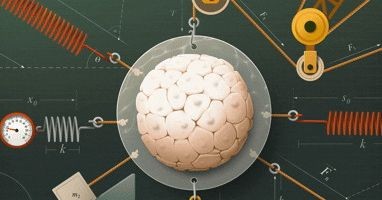
For centuries, biology has focused on genes as the primary architects of life. But a growing body of research reveals that physics—specifically mechanical forces—plays a far more crucial role in shaping organisms than previously understood. From the development of embryos to the spacing of feathers, physical processes are not just influenced by genes, but actively drive growth and form.
Beyond the Genetic Blueprint
The traditional view of biology emphasizes chemical cues triggered by genetic instructions. However, this picture has often felt incomplete. Modern imaging and measurement techniques now allow scientists to observe the mechanical forces at play, revealing how tissues push, pull, and rearrange themselves in response to their material properties. This shift in perspective is reviving interest in pre-genetic models of biology, echoing ideas first proposed over a century ago.
In 1917, D’Arcy Thompson published On Growth and Form, highlighting the striking similarities between shapes in living organisms and those that emerge in nonliving matter. Thompson argued that physics, too, shapes us, a thesis that is experiencing a resurgence in popularity. The question now is not whether physics matters, but how it interacts with genetic instructions to sculpt organisms.
The Marangoni Effect and Embryonic Development
One striking example of this interplay comes from recent research on embryonic development. A team of biophysicists in France discovered that the Marangoni effect—the same phenomenon that causes “wine tears” to form on the side of a glass—is responsible for the pivotal moment when a blob of cells elongates and develops a head-and-tail axis.
The Marangoni effect occurs when two liquids with different surface tensions meet. The liquid with higher tension pulls on the other, creating a flow. In the case of embryonic cells, genes create a difference in surface tension, causing cells to flow and elongate the developing organism. This mechanical process is not a replacement for genetic instructions, but a direct consequence of them.
Beyond Embryos: Feather Formation and Cellular Stretching
The influence of mechanical forces extends beyond embryonic development. Researchers studying bird feather formation found that the regular spacing of feathers isn’t dictated by genetic signals alone. Instead, genes set the stage for mechanical forces to pattern follicle development. The molecular signals influence the material properties of the tissue, allowing physical forces to take over.
Similarly, studies on fruit fly embryos have shown that cells don’t just rearrange themselves; they stretch. This stretching is directly attributable to gene activity that makes cells elastic. The relationship between force and extension follows Hooke’s law—the principle that materials stretch in proportion to the force applied. The timing of the stretching depends on the square root of the applied force, a behavior linked to the production of the protein actin. Blocking actin production eliminates the elastic response, confirming its role in the process.
The Interplay of Scales
The key challenge now is understanding how these forces operate across different scales, from genes to cells to tissues. It’s not a simple linear progression where molecular instructions dictate high-level properties. Instead, processes emerge together, with mechanical forces playing a critical role at multiple levels.
The work challenges the traditional view that regulation emerges solely from the molecular level. In feather development, for instance, changes at both the molecular and tissue levels occur simultaneously. This suggests that biology isn’t just about what genes tell cells to do, but about the physical constraints and forces that shape their behavior.
As physicist Alexandre Kabla puts it, “where there’s motion, mechanics is likely to be involved.” The growing recognition of this principle is reshaping our understanding of life itself