



Super Bowl LVIII wasn’t just a football game; it was a cultural flashpoint set against the backdrop of Silicon Valley. The event unfolded at a moment where artificial intelligence, political polarization, and cultural clashes dominated headlines, making the game itself almost secondary to the wider drama.
The Silicon Valley Setting
Levi’s Stadium, located in the heart of tech country, was just miles from the headquarters of major AI players like Nvidia and AMD. These companies are locked in a fierce competition for dominance in the rapidly evolving AI landscape, and their rivalry spilled over into Super Bowl advertising. The presence of autonomous vehicles on nearby roads served as a visible reminder of the technological revolution reshaping daily life.
Prediction Markets and Legal Gray Areas
The lead-up to the game saw a surge in sports “trading” activity on platforms like Kalshi and Polymarket. These prediction markets allow users to bet on outcomes beyond traditional sports wagers, even in states where sports betting is illegal. The Super Bowl provided a high-stakes testing ground for these emerging markets as they strive for mainstream acceptance.
Bad Bunny, Culture Wars, and Political Backlash
The halftime show headlined by Bad Bunny ignited a predictable backlash from conservative circles. Turning Point USA organized an alternative “All-American Halftime Show” featuring Kid Rock and Brantley Gilbert, underscoring the deepening cultural divide in the U.S. The controversy over Bad Bunny’s inclusion highlights the growing tensions between mainstream entertainment and politically charged resistance.
Immigration Concerns and Protests
Rumors of potential ICE enforcement actions at the Super Bowl circulated despite assurances from NFL officials and California Governor Gavin Newsom that no such operations were planned. Anti-ICE protesters still gathered near the stadium, reflecting ongoing concerns about immigration policy and enforcement practices.
Fan Reactions: A Mix of Excitement and Discomfort
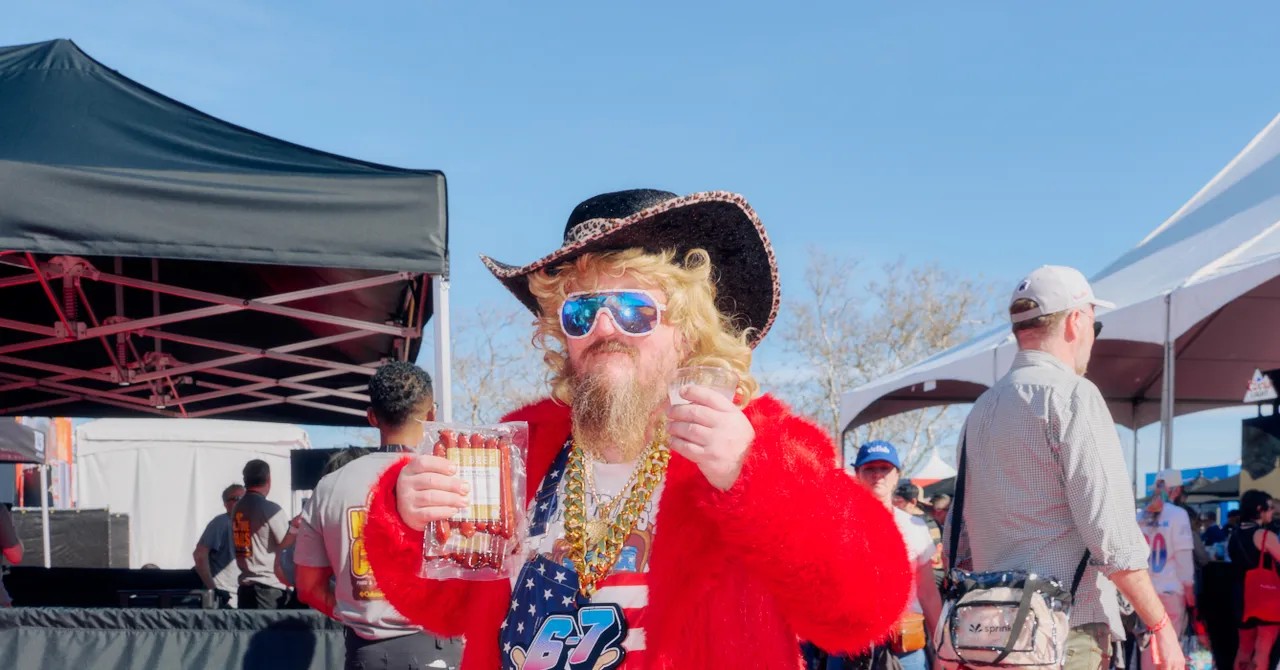
Interviews with tailgaters revealed a diverse range of perspectives. Some fans, like Shavon Wilson from Milwaukee, expressed excitement about the event’s atmosphere and the journey to get there. Others, such as Ryan Jackson, were fascinated by the nearby tech industry but admitted to limited understanding of AI.
Some fans, like Jim Lockhart from Boston, openly embraced aggressive betting strategies, while others, like Bruce Asmussen from Iowa, emphasized the importance of unity and avoiding political divisions.
Matt Luzio from New Jersey, representing a group of long-time Super Bowl attendees, underscored the NFL’s ability to enforce a temporary truce in a polarized society. Michael Robinson from Myrtle Beach, South Carolina, shared a humorous take on the controversy, noting he now enjoys Bad Bunny after hearing him on satellite radio.
The Future of Spectacle
Super Bowl LVIII was a microcosm of broader societal trends. The convergence of sports, technology, politics, and cultural identity created an event that was as much about what happened off the field as on it. The NFL’s power to temporarily override social tensions underscores its unique position in American culture.
The Super Bowl remains a spectacle that transcends football, serving as a reflection of the nation’s anxieties, aspirations, and contradictions.