


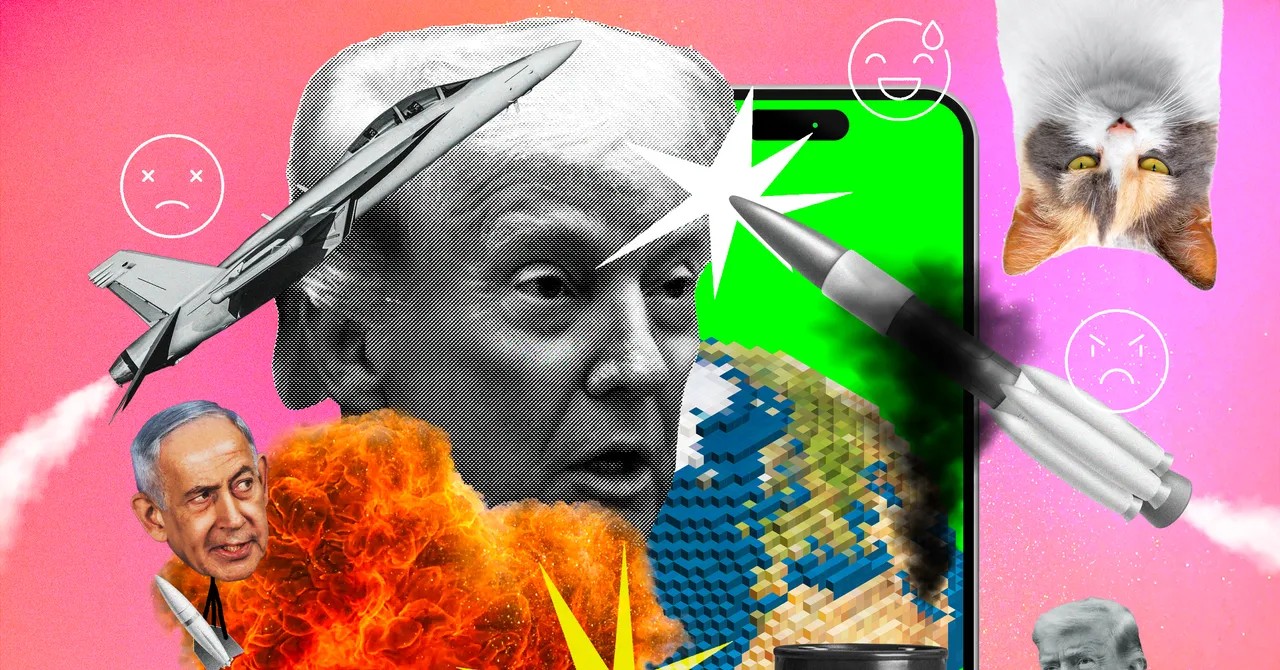
As recent ceasefire negotiations between the US and Iran, and Israel and Lebanon, have dominated global news cycles, a different kind of narrative has been unfolding in real-time: the transformation of conflict into digital content. On social media, the gravity of war is increasingly being filtered through the lens of memes, viral audio, and dark humor.
While humor has long been a human response to tragedy, the digital age has fundamentally altered how these expressions function, turning them into high-speed tools for both psychological survival and state-sponsored propaganda.
The Dual Nature of Digital Humor
Across different geographies, the tone of “war memes” reflects the varying proximity to actual danger.
- In the West: The tone is often detached and cinematic. Users joke about being drafted with “Bluetooth-enabled” weaponry or use viral songs like “Bazooka” to soundtrack clips of military life. This humor often draws from “video-game logic”—a sense of “happy violence” where destruction feels consequence-free and distant.
- In the Middle East: The humor is often more fatalistic. Memes might depict delivery drivers dodging missiles or “Eid outfits” being replaced by tactical vests. Here, humor isn’t just entertainment; it is a mechanism for reclaiming control in an environment where control is non-existent.
“Where there is hardship, there is satire,” says Middle East scholar Adel Iskandar. “Where there is loss of hope, there is hope in comedy.”
The Viral Mechanics of Conflict
The speed at which these memes travel is driven by platform algorithms that prioritize engagement over accuracy. Unlike traditional news, a meme does not need to be factual to be successful; it only needs to be relatable, simple, and easy to remix.
This creates a significant disconnect in how the world perceives crisis:
1. Speed vs. Substance: Memes replicate like viruses, spreading far faster than nuanced journalistic reports.
2. Context Collapse: Because memes rely on emotional shorthand, the specific political or human realities of a conflict are often stripped away, leaving only a hollowed-out template for jokes.
3. The Proximity Gap: There is a profound divide between those watching war as a “mediated spectacle” (clips and edits) and those experiencing it as a lived reality (sirens and rising prices).
Weaponized Content: When States Speak “Meme”
Perhaps the most significant shift is the evolution of state propaganda. National governments are no longer just issuing press releases; they are adopting the visual language of internet subcultures to influence global perception.
Modern propaganda now utilizes:
* Cinematic Edits: Splicing real combat footage with Hollywood-style soundtracks.
* Gaming Aesthetics: Using AI-generated animations (such as Iran’s Lego-style military victories) to make political messaging feel like entertainment.
* Identity Reinforcement: Creating highly shareable content designed to project “normalcy” and resilience.
These efforts are incredibly effective. Reports indicate that state-produced viral content can generate billions of impressions, often dwarfing the reach of traditional news outlets. When propaganda is wrapped in humor or high-production entertainment, it becomes much harder for the average user to critique or resist.
The “Illusion of Knowledge”
The danger of this trend is not necessarily that people are uninformed, but that they suffer from a false sense of fluency.
A 2024 study published in Frontiers in Psychology identified an “illusion of knowledge,” where heavy social media news consumption makes users feel well-informed even when their actual understanding of a topic remains shallow. This is exacerbated by the fact that while many—particularly young people—rely on social media for news, they still rank traditional television as a more trusted source.
When news is consumed in fragmented, meme-sized bites, the complex political landscape is replaced by a series of disconnected emotional reactions.
Conclusion
While memes can serve as a vital psychological tool for coping with hardship, their evolution into a primary medium for news and propaganda poses a risk. They create a world where the spectacle of war often replaces the reality, leaving audiences with a sense of being informed while remaining profoundly disconnected from the truth.