



Fans are boring. Or so you think. Then you see a price tag that laughs at your Dyson budget.
You expect a Dyson AM07 to cost around $400. That’s the luxury tax for owning a brand that turned appliances into status symbols. But there’s a Japanese company called Balmuda that says “hold my tea” (or coffee, depending on which of their $500+ brew tools you buy). Their latest release isn’t called The Fan. It’s the NatureWind Studio.
It costs $429.
Balmuda isn’t household fame in the US. In Japan, they are revered for minimalist gadgets. They make a toaster, a speaker, a teppanyaki grill. They also made this fan over a decade ago as the “GreenFan Studio.” Now, finally, it has hit US shores in early June, available in stark black and white.
What makes the NatureWind Studio airflow different?
Here’s the pitch: mimicking a natural outdoor breeze.
Most fans blow air in a straight, annoying line. This one uses a patented dual-blade design. There’s a slow inner blade and a fast outer blade. Together, they churn out a wide, gentle, almost invisible wind. It doesn’t feel like machinery. It feels like walking through tall grass in August.
Balmuda claims it hits just 9 decibels. I can’t verify the number—my living room isn’t a vacuum—but I can verify the silence. It is inaudible. Truly. You will forget it’s running until the sweat stops.
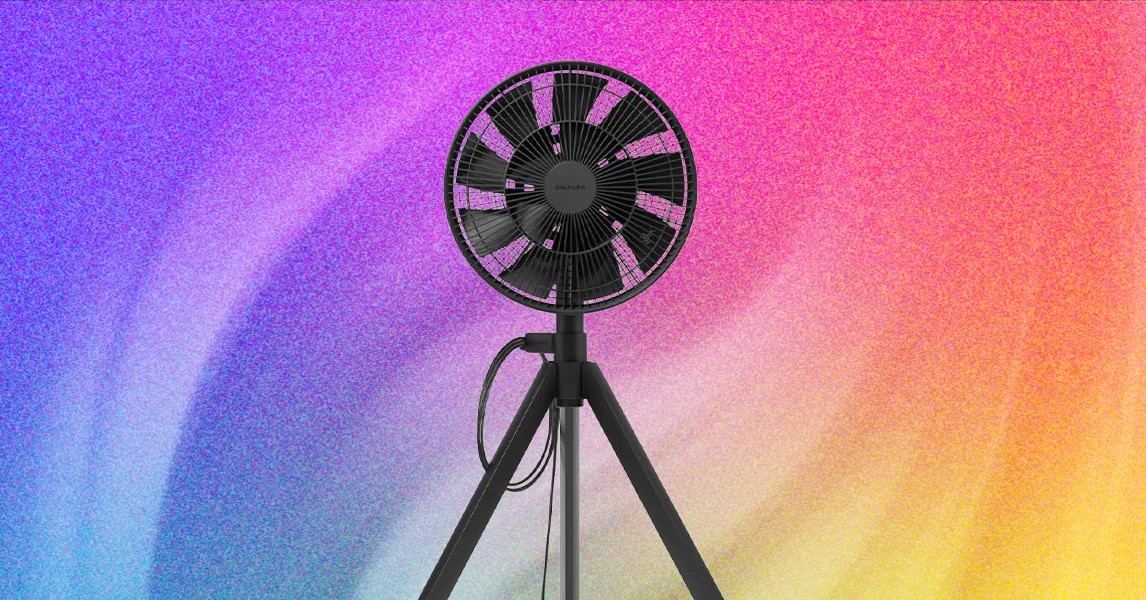
There are no smart features. No app. No Wi-Fi. Just a pedestal that looks like a caged windmill on heavy tripod legs. It does exactly one thing, and it does it beautifully.
But $430? That’s a lot for plastic and metal.
How easy is it to build and clean?
Forget the cheap fans that come pre-assembled in a cardboard coffin. This arrives in parts. You have to attach blades, assemble the guard, snap on the legs. Took me 20 minutes. Not hard, just fiddly.
The upside? It’s designed to be taken apart. Cleaning the NatureWind Studio is actually possible. Most pedestal fans trap dust behind cages you can’t reach. Here, you pull the blades out, wipe them down, put it back together. The motor housing is metal. The feel is precision-built. You pay for materials that won’t rattle to death after two winters.
It doesn’t adjust height. No rechargeable battery. It’s a corded unit with a surprisingly long 10-foot fabric-covered cord. There’s even a little hook on the stalk to tie the excess. Nice touch.
But here is the sin. No remote.
Why do you own a $429 fan? To sit under it. Do you want to walk across your living room to lower the speed? To stop the side-to-side swing? Of course not. You sit still. You sweat. You curse the decision to spend an extra $250 over a cheaper rival that includes a clicker.
The oscillation is also limited. It goes side to side. It does not tilt up and down like many competitors. You get a horizontal breeze, nothing more.
Is the natural breeze effect actually useful?
You’ve probably seen “Nature Mode” on new smart fans. They randomize the speed. Low. High. Low. High. It’s supposed to feel natural. It mostly feels like your fan is having a seizure. It is distracting.
The NatureWind Studio avoids this chaos. Its breeze is consistent. It pushes air wide and soft. It won’t rip your paperwork off the desk.
But don’t expect Hurricane Force.
If you have a 14-foot ceiling, this fan won’t move the air. I measured it. Even in Jet Mode —the top setting, marked by an airplane icon—it hit 925 feet per minute (fpm). My anemometer confirmed this. It’s decent. But compare that to the Vornado EOS 9 ($150). That ugly thing pushes over 1,400 fpm. It circulates air like a vacuum. It’s loud. It’s bulky. It works.
The Balmuda is quiet. The max volume stays just above 50 decibels. But it sacrifices raw power for style and silence.
One small victory: No lights. Many fans have bright LEDs screaming their status at 3 AM. This unit has two rows of dot-sized LEDs. Faint. Discrete. Perfect for sleeping without feeling like you’re in a spaceship.
Who should buy this quiet pedestal fan?
Let’s look at the competition. Because spending $430 demands scrutiny.
Take the Dreo TurboPoly 765S ($160). It’s half the price. It’s quieter than it sounds. It has a remote. Vertical oscillation. Height adjustment. Matter connectivity. It does everything the Balmuda does, but smaller and cheaper. Why buy Balmuda? Because Dreo doesn’t feel like heirloom quality. Balmuda feels like art you use.
Then there’s Vornado. Their VFan ($209) looks retro. The Ara ($290) looks futuristic. Both are louder. Both are rougher on the ear. But they have five-year warranties. Balmuda offers two years. You pay more, but you insure it less.
And what about the Dyson AM07? The OG designer fan. It’s $70 cheaper. It’s bladeless (safe for toddlers who might put fingers where fingers shouldn’t be). It’s iconic.
But here is the rub: The Dyson is louder at 31 dB. And its airflow is narrow. It blasts a cone. The NatureWind Studio paints a wide, soft wash over your sofa. If you care about how the wind feels, not just that there is wind, Balmuda wins on texture.
I prefer the breeze. It’s one of the finest I’ve ever felt. Soft. Wide. Invisible.
But do I prefer the price? No.
I’m still not convinced that silence justifies the premium. It’s a beautiful machine. A refined machine. But we’re asking for luxury pricing for something that doesn’t talk to my phone, doesn’t come with a remote, and can’t lift the hot air off the ceiling.
You’re buying a feeling. A specific, gentle feeling.
If you value that feeling more than a remote control or warranty, maybe it’s worth it. But look around the room. Do you really need $430 to breathe comfortably?