



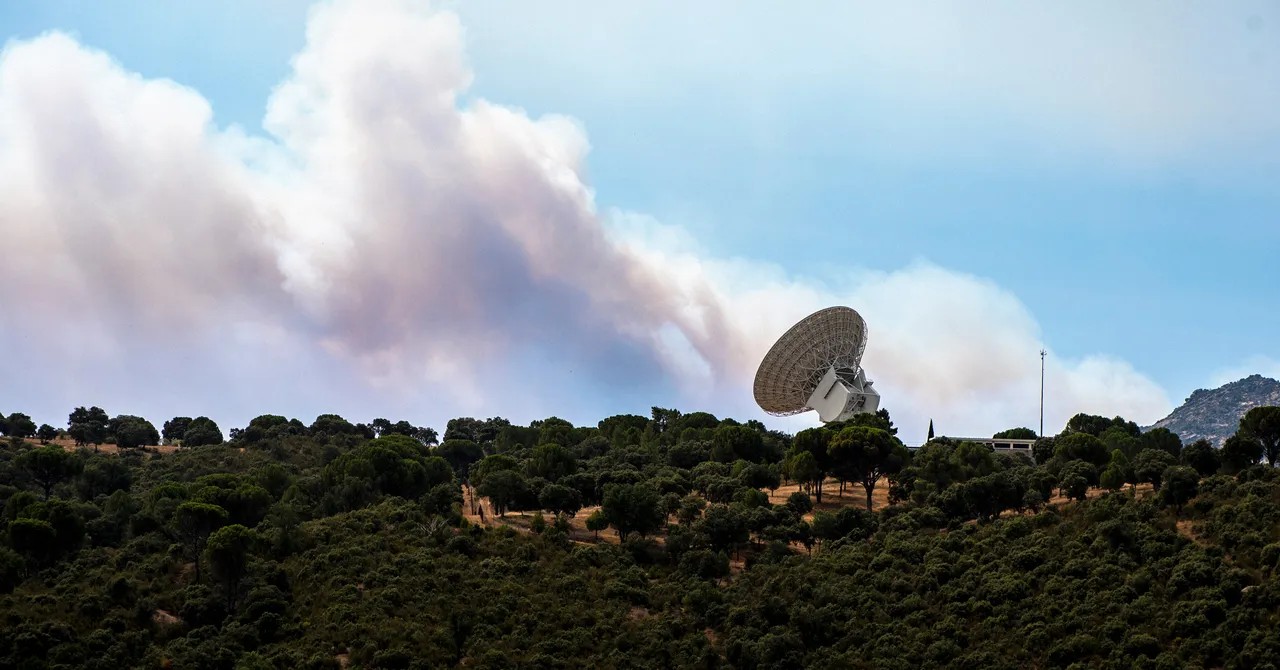
Climate change doesn’t respect borders. Or telescopes. On Friday, runaway wildfires in Spain engulfed one of the critical hubs for NASA’s Deep Space Network. This isn’t just some random radio dish. It is one of the three ground stations on Earth that keep us talking to the James Webb Space Telescope, the Artemis moon missions, and Voyager 1. That’s the most distant human-made object.
Impact on the Madrid Deep Space Communications Complex
The fire broke out near Robledo de Chavela. That’s the municipality housing the Madrid Deep Space Communications Complex.
Spain declared a wildfire emergency. Why? Because multiple blazes went completely out of control near Madrid. Evacuation orders were issued for 60,000 residents. The scale is massive. Roughly 200,00 people across Spain and neighboring France have been told to leave their homes.
Photographers captured the scene. It looks apocalyptic. Radio telescopes stood surrounded by thick smoke and flames. But the people made it out.
A NASA spokesperson told WIRED that all personnel were safely evacuated. The agency is waiting. They need to know if the sensitive equipment survived. “Any potential damage will be assessed when It is safe to do so,” they said. They might get in as soon as Saturday.
“While the fire has now passed through the observatory… It remains unclear what impact the flames may have.”
So, what happens while they wait? The conversation doesn’t stop.
How NASA Maintains Space Communications
You might wonder, how do we talk to deep space if one ear is blocked? We use the others.
The Madrid facility, along with stations in Canberra, Australia and Goldstone, California, form the largest and most sensitive scientific telecommunications system on the planet. It’s a trio. If one fails, the others pick up the slack.
NASA stated they had seamlessly transitioned support for mission operations to Goldstone in California. That means the data keeps flowing. The James Webb Space Telescope keeps sending its images. The commands keep going out. The link to Voyager 1 remains unbroken.
This network allows NASA to:
– Transmit information to spacecraft across the solar system
– Transfer data from distant observatories
– Conduct radio astronomy observations
It’s a very important collection of instruments. Losing one node hurts, but it doesn’t break the system. Yet.
Europe’s Wildfire Crisis and Climate Factors
Spain is not alone in this mess.
France is burning too. Firefighters in the Bordeaux wine region watched as skies turned orange. Ash washed up on the beaches where people used to relax. Interior Minister Laurent Nunez called the situation extreme. The fire became self-sustaining after a wind shift. It moved east, toward the city. They had to reorganize their response to stop it from advancing.
Why is this happening now?
Heat domes. They are camping over Europe. And the UK. Climate change is driving record-high temperatures. Hot weather dries out vegetation. It primes the forest to burn. All it takes is an errant spark.
This pattern looks familiar. We’ve seen it in Ontario, Canada. We saw it in the US Pacific Northwest.
There is a brief reprieve expected over the weekend. Cooler weather should help firefighters gain some ground. But don’t celebrate yet. Temperatures are expected to spike again on Monday. Projections show them climbing throughout the week. Up to 18 degrees Fahrenheit (10 degrees Celsius) above normal.
That heat could reignite embers in Spain or France. Or spark entirely new blazes.
The smoke clears eventually. The damage remains. And the fires keep coming back.