




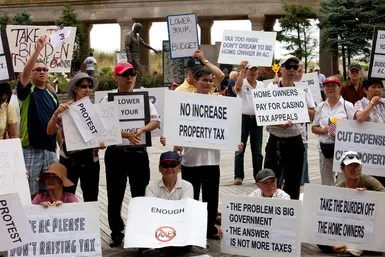
Why the #AtlanticCityPropertyTaxProtests matter to all homeowners
The images of angry residents on the streets of Atlantic City in 2014 were more than just a historical footnote. This is a stark reminder of how the relationship between homeowners and municipalities can become fragile as property taxes rise. Understanding the mechanics of this levy is no longer optional for anyone looking to make smarter financial decisions. This is essential.
Property tax is levied mainly on land and buildings. However, definitions can quickly become confusing. In the United States, this tax is typically not limited to real estate, but also includes business equipment, farm inventory, motor vehicles, jewelry, and furniture. Some jurisdictions also cover intangible assets such as bonds, mortgages and equity.
This is a trap that catches many people. The tax is calculated based on the gross value. It ignores debt. If you own a $500,000 home and have a $450,000 mortgage, the tax authority doesn’t care about your ability to pay. They focus on the gross value of assets. This is an important distinction for anyone concerned about their net worth and their actual tax liability.
Not everything is property tax
It is important to distinguish what is “not” a property tax. Transfers of property through sale, gift or inheritance are different types of taxes. Special assessments on public improvements are payments for specific services rather than general taxes. Some income taxes related to the yield of the land are also not included in the normal property taxes.
Confusion can lead to poor financial planning. You can think of the fees you pay at closing as a recurring property tax. This is not true. Understanding the differences can help you more accurately predict your annual cash flow obligations.
How does assessment determine burden?
The scope and tax rate of property tax vary greatly from region to region. This difference depends on the legal framework, administrative capacity and traditions. But the most immediate factor for individual homeowners is how the property is classified.
Local governments often use classification to adjust effective burdens. Part of the value of machines, forests, mines and securities can be left out. Certain types of properties may have lower rates. This is why two homes on the same street can have very different taxes. Depending on the property type, one of the properties may be for commercial use or the owner may have successfully challenged the assessment.
In simple farming communities, property taxes may be closely tied to benefits received from public services. The more property you own, the more you benefit from roads, schools and police protection. In complex industrial societies, this connection is broken. Your tax bill reflects your estimated value, but not necessarily the public service you consume.
The Revenue Reality
In most states, property tax revenue goes to local or state governments instead of the state treasury. In the United States, this tax is about half of all local government revenue. It is the lifeblood of municipal services.
This creates tension. Municipalities need income. Homeowners need affordability. If the estimated values do not keep pace with the price level, revenues lag behind national income growth. Computerized assessment systems can help fill this gap, but challenges remain in many areas.
Collection costs are also a hidden factor. For example, in Greece, property taxes make up less than 0.5% of all tax revenues, but consume more than 1% of tax administration expenses. This inefficiency has to come from somewhere. This usually means a higher tax rate for taxpayers or reduced services in other areas.
Historical transition from land to value
The history of the property tax is a history of attempts to find fair assessment standards. In ancient times, taxes were calculated based on the surface area of the land. Medieval systems often used the property’s gross production or annual income. Later, the concept of “ability to pay” emerged, mixing personal property with intangible wealth.
Personal property is difficult to identify. Intangible assets are almost impossible to tax because they are easy to hide. This led to the abolition of the “general property tax” in the United States.
In the early days, the New England colonies taxed all visible estate. By 1800, some states had enacted “general property tax laws.” By the mid-1800s, property taxes had become the most important source of revenue for all states. However, the inclusion of intangible assets results in double taxation. A mortgage is a claim on real estate. Taxing land and mortgage is unfair and easy to avoid.
Currently, real estate alone accounts for the majority of the U.S. property tax base. These calculations include very little intangible assets. While this simplification reduces enforcement costs, it also reduces local government resources.
State vs. Local Control
Property taxes in the United States are an important source of revenue for local governments. State governments relied heavily on it. At present, few states receive more than a small amount of revenue from this source.
However, the state still evaluates the operating property of railways and utilities. This creates a patchwork system. Some authorities insist that the state takeover of property taxes. They believe that the state will manage more effectively. The government also wants to eliminate inequality in municipalities’ ability to collect taxes. This is particularly important for public school funding, where local assets determine educational resources.
This structural imbalance is important when buying a home. Local tax rates do not only reflect local needs. This reflects the disrepair in how we fund for education and infrastructure. The protests in Atlantic City aren’t just about high bills. They were about a system where the burden falls disproportionately on those who can least afford it, and where debt and economic adjustment mechanisms are slow and imperfect.
The next time you get a property tax bill, don’t look at the total. Let’s look at the evaluation method. Look at the exemptions. Understand that this system is designed to tax total value, not net worth. This fact changes the way you think about mortgages, equity and long-term housing costs. The debate continues about who should impose the tax and how it should be calculated. But the impact on your wallet is immediate and undeniable.
Who manages the real estate tax administration?
State employees control almost every phase of real estate tax administration. They determine what is taxable, determine its value, apply tax rates and collect the cash. When taxes follow income, the focus shifts from the capital value to the real return on the property. However, the evaluation is still a matter of judgment. This is not an automatic by-product of other transactions such as payroll or retail. Because the sales price may be manipulated to lower the tax, the reported market price may become unreliable for some assessors.
Valuation model: capital, market, rent
Three main approaches dominate modern assessment. European countries generally rely on capital values. The logic is that you can estimate the capital value by treating the rental value as a return on the capital. The US and many European countries are currently struggling to find fair value estimates. Asia has traditionally focused on rental value. In this model, taxes are calculated based on the average gross rental income earned from the property under normal conditions. Some Asian jurisdictions take a simpler and perhaps less fair route. We charge a fixed amount instead of the actual market performance of the country’s unit of measurement.
The Physical and Data Challenges
Administrative headaches stem from two sources. First, defining what actually exists. Where are the boundaries? What does the terrain look like? How many machines are in the inventory? Second, assigning value. This requires professional staff. Requires access to various data streams. Local governments rarely have the capacity to provide this service at scale.
Better management of property tax requires sharper mapping. Improved methods are needed to accurately describe the properties. More data sources and more sophisticated valuation techniques would be very helpful. The calculations range from simple to complex.
「The value determined by the purpose of taxation is not a consequence or an automatic side-product of transactions carried out for other purposes.」
In the case of a single-family house, the sale of similar properties (i.e. comparable properties) provides a solid basis for the evaluation. Office and apartment buildings are valued by their income yield. Unique properties require different approaches. Factory buildings and special structures that are integral to a business should be valued based on reproduction costs. This means estimating the cost of duplicating the structure less depreciation. The valuation of a company’s stock, machinery and equipment often depends on the company records.
The Professional Gap
A good assessment requires permanent professional staff. They need a full-time salary to the private sector. They must be free from political pressure. Such staffs is almost non-existent in many places. In the US, appraisers often work part-time. They are often elected. They are poorly paid. They frequently lack the specialized training now considered essential.
Inexperience is associated with favoritism and corruption. This happens at assessor level and in local government. Staff have few resources to keep all assessments up to date. The pace of new construction exceeds the evaluation cycle. Maps and records become outdated quickly. With the latest data processing technology, the burden has been reduced to some extent, but the work required is beyond what most governments can support.
Appeal and market reality
The tax base depends on an official’s estimate. There is no free market test like sales tax. There is no self-reporting like income tax. Taxpayers are not involved in determining the assessment. Local governments often offer a appeals process. The results are often meaningless. Some taxpayers are simply do not know of the process. Some think the potential savings aren’t worth the effort.
The appeals process is complicated by a common practice. In most countries, real estate is valued at a fraction of its current market value. The law might specify 100 percent assessment. The reality is different. These lower-than-market valuations are compensated by higher tax rates. They are fighting against a system that underestimates everyone, not just themselves.
Nominal tax rates are a lie. Appraised values are often below market value, giving a false impression of what owners are actually paying. If you only look at the stated rate, you miss the real burden.
Historically, math was easy. Local governments get their income almost entirely from real estate tax. The calculation is easy. Divide the estimated expenses by the total estimated value. Let’s say the city needs $400,000 to operate. If the total assessed value of all properties is $40 million, the tax rate is exactly 1%. directly. Predictable.
Those days are over.
Now, officials start with the revenue they expect to receive at current tax rates. Then they ask voters if they would approve tax increases to fund the new services. This is a political calculation, not a mathematical calculation. When managers want to keep general fund rates low despite an increase in demand for a particular service, they often set “special rates.” In this way, widespread voter opposition can be avoided by separating costs from special needs.
How to change state property tax policies
US state governments have traditionally viewed property taxes as a flexible tool. They get their main income from other tax sources. If these resources are not enough, the property tax rate is increased. If there is a surplus, they lowered it.
Many states still have this constitutional authority. If your primary source of income fluctuates, the ability to adjust rates up or down is still an important tool in balancing budgets.
Understand the caps and limits on tax rates
Rate limitations are everywhere. They are based on state constitutions or statutes. All levels of government, including counties, cities and school districts, are subject to maximum ceiling rate.
These caps are not always static. They can be changed by a referendum or a special legislative act. But do these restrictions really prevent the growth of public spending? The evidence is unclear. It is difficult to assess their effectiveness.
Clearly, it has unintended consequences.
To circumvent these maximum amounts, special districts were established. These units have an independent taxing power. They operate outside the standard rate limitations. Therefore, while the general fund may be limited, the total tax burden may still increase through these alternative channels.
As a result, the system is fragmented. You pay the capped rate for your city. An additional fee is charged for water or fire protection. The nominal rate appear to be low. The total cost is higher. The accountability is diluted.
How paying real estate tax really affects your wallet
Property taxes are a textbook example of a tax incidence. It doesn’t matter who cuts the check. The question is, who will really lose?
Look at the ground. This is real estate. It cannot be moved. Imposing taxes usually hurts the owners. This is called capitalization. Market prices have been adjusted downwards corresponding to the future tax liability.
Let’s think about math. Let’s say that the plot of land generates an annual income of $1,200. The yield is 6% and the value is $20,000. Additional tax $300 per year. Net profit fell to $900. The value dropped to $15,000. Buyers pay less upfront. They pay no taxes on top of the purchase price. The price is the discount for the tax.
This does not mean that the land will become cheaper in absolute terms. This means that land doesn’t rise as fast without taxes. This is an appreciation brake, not a crash.
New structures change the equation
The building becomes chaotic. business space of the new home. improve.
The burden has shifted. It depends on the area.
If only one small town imposed this tax, developers would likely pick it up themselves. Or raise rents. Or cut wages. This is a localized game.
But the situation would change if “all” jurisdictions taxed property. Capital owners take the hit first. Savings will decrease. Prices are going up. Wages stagnate. The long-term effects extend beyond owning a home. It affects the whole economy.
Business costs
Construction requires money. Taxes make capital expensive.
Companies consider real estate tax as an operating expense. They try to pass it on.
Prices are higher for consumers. You pay less to your suppliers. Workers are paid low wages.
If you can’t pass it on? ROI decreases.
In areas of low taxation, competitors have an advantage. They don’t face the same pressures. They can steal market share. Or simply enjoy higher margins.
Who really pays? Usually local consumers. Sometimes local labor. Usually local landowners.
This takes time. A few months. Maybe a few years. Prices will not change immediately.
Regulated utilities are different. The agency determines the prices. This change is certain. But it’s slow. Bureaucracy marches to the beat of its own drum.
Homeowner’s dilemma
Taxes cannot be transferred to your home.
you are trapped.
But then look at the purchase price. It was discounted for the tax The lower the tax, the higher the land price.
So is this a burden? Sort of.
It acts like a consumption tax. In the US, they are generally taxed more heavily than most other consumer goods.
The income tax deduction helps. The net burden is reduced. But it doesn’t eliminate it.
Who really pays?
It is almost impossible to measure the burden by income level.
the capitalized land value cannot be accurately determined based on price. It is hidden in the price of the property.
If you think of it as a tax on capital income, it becomes a progressive tax. Wealthier households pay more in relation to their income.
But let’s take a closer look at taxation in one jurisdiction. The burden is on local consumers. And local workers. and local landowners.
This makes it regressive. Low-income households spend a large part of their income on these local expenses.
Companies transfer their share to consumers. Let’s think about utilities. electricity. telephone service. You pay their tax liability with your monthly bill.
So, is it proportional? Slightly regressive?
it’s complicated.
One thing is clear. The redistributive effect is large. Property taxes are used to finance schools. They finance services for low-income people. Money flows from taxpayers to public goods.
Whether this is fair depends on how the costs and benefits are weighed.
The math is clear. Not so with politics.
A hidden bias in real estate taxation
The problem with property taxes is not just their existence. It’s that they are uneven. This “horizontal inequity” means that two people with the same property value can pay very different amounts depending on who assesses the value and how closely the rules are applied. The burden is not evenly distributed. It hits certain industries even harder.
Railroads and utilities generally have higher taxes than other industries. Housing consumption and commercial development have different weights. Agriculture in the United States is an example of this inconsistency. Property taxes on farmland are usually low compared to the market value of the land. But when you look at the real income of agriculture, the tax burden can seem surprisingly heavy. This is a disconnect between asset value and operational reality.
This tax has been around for centuries and is built into the economy. Some of the tax burden is reflected in the price of the property, requiring buyers to pay more up front to avoid high recurring taxes. Others have been adapted over time. The result has been a system that has eliminated some inequalities but hardened others.
Who Gets Off the Hook?
Exemptions have eroded the property tax revenue base for decades. In many regions of the United States, about one-third of the total land area is tax-free. However, most of these are not loopholes for the wealthy. This is government land. Roads, parks, public schools or city buildings are not taxed. Even if that happens, it would just be a left-to-right transfer within the same government agency. This is administrative noise.
State and federal property is also often exempt, although some jurisdictions require “payments in lieu of taxes” to soften the blow. In addition to state ownership, the number of exemptions is also growing rapidly. Religious institutions, schools and charities have largely off the hook. In some countries, land below a certain minimum value is completely tax-free.
These exclusions create gaps in coverage. They could shift the burden to taxable assets and raise the tax rate for those left in the system.
Strategic exemptions and social policy
Not all exceptions happen by chance. There are also deliberate policy tools. Municipalities grant exemptions to attract new companies and promote the construction of low-income housing. This is one way to support growth.
Residential exemptions are also common. Many places have a “homestead” exemption that reduces a portion of your tax bill. This is usually tied to the owner’s income and is intended to provide assistance to those most in need. Seniors, disabled and veterans often take extra breaks. These are not just tax cuts. They are social safety nets built into fiscal code.
Some authorities allow income tax exemptions for residential property tax. This is a hybrid approach that combines federal or state incentives with local taxes. The goal is to lower the total costs of a certain group’s homeownership.
The system is messy. high-value utilities pay high taxes, but large tracts of land are tax-free because they are public goods. Farmers are stuck between low property taxes and high income pressures. And exemptions vary by jurisdiction.
Is it fair? It depends on whose ledger you are looking at. For elderly veteran, their home is a lifeline. For small business owner bearing the brunt
Hidden costs of property tax
Local governments in the United States do not rely solely on property taxes to operate. But they rely on them enough to matter. It creates financial independence. This independence allows for the decentralization of power. Citizens can choose which services they finance. It feels like freedom.
But taxes do more than fill the budget. It changes behavior. When interest rates go up, people react. They transfer money. They change their plans. The goal is simple. The goal is simple: pay less.
High rates on buildings put cities at a disadvantage. They compete for capital. The national competition is fierce. International competition is getting tougher all the time. Unless you have something else to offer. Something better.
Where does the capital come from? Saving. The relationship between property tax and capital supply is complex. Unclear. However, the results were as expected. Factories hate high taxes. Production facilities requires significant investments. If the taxes are not worth the benefits, the money will be spent elsewhere.
Older properties suffer the most. Taxes distort the allocation of resources. In new construction, the surface unit costs are higher. Old ones pay less. Slums pay very little.
This ignores reality. It ignores the cost.
Police. Fire protection. These services do not matter whether the building is new or old. The price is the same. Probably more for older stuff. However, as buildings age, users pay less. The calculation doesn’t work. Public spending will remain unchanged or increase. Fees have been reduced.
Twist it. Change from a bad apartment to a better one. I’ll pay more. This does not necessarily mean that you will receive more services. This is a punishment for improving your life.
Some practices can cause significant harm to communities. The city has to rebuild old buildings. they need it badly. But they are often funded by taxes that reward decay.
Owners of deteriorated structures now get a respite. Fines are imposed on the new owners. Every time interest rates on buildings (as opposed to land) go up, the incentive disappears. Not suitable for maintenance. It will prevent new construction. It still leaves abandoned buildings. This is very contradictory. This is bad policy.
Tax rates vary by locality. This forms an island. A low-tax enclave.
Some communities have a strong tax base. They have obligations proportional to their income. You can keep interest rates down. That’s where the capital flows. They attract investment.
Other places are also in trouble. They use zoning to prevent expensive real estate. High density housing. Think schools. Let’s think about our children. Dense housing requires more services. So they exclude it.
This changes the burden. Tax rates in other areas must be increased to compensate for this difference. The imbalance of the public finances is growing. Older areas also suffer. They face challenges they have never experienced before.
Look at the edge of town. The suburb thrives on low rates. Urban centers often face high rates. More problems arise. Downtown businesses are bleeding.
High taxes on structures promote horizontal growth. Vertical growth disappears. Sprawl expands. More land is consumed. The impact on the surrounding areas is significant.
Let’s take Britain as an example. Grades are determined by income. Unused lands generate little revenue. This is significantly below optimal usage. The incentive to use it effectively is gone. You just own the property. You wait. There are no expenses.
The second is natural resources. Timber. Minerals. Property taxes affect logging and mining. It can lead to premature exhaustion. Uneconomical depletion.
Many states are witnessing this. They switched. They turn to “severance taxes”. Based on production. Based on extraction. Prevent wastage. Align incentives.
This switch is important. It changes the way we value what’s underground. It changes our judgment of what’s above it. However, the system is not fixed. It’s still changing. Still reacts to stress.
Why site-value taxation is still a controversial tax instrument
This idea is not new. Eighteenth-century French physiocrats liked this concept. But Henry George really hit the mark. His book Progress and Poverty (1879) did more than propose a land tax. argued for a single tax on land. The goal is simple. abolish other taxes. He relied on British economists such as David Ricardo and John Stuart Mill. This logic is good enough that it is still debatable.
The central basis of land value taxation is fairness. Much of what we pay for land has nothing to do with the land itself. It matters what the community builds around it. Streets. Schools. infrastructure. This value is created by society. You can’t charge a fee for bringing land into existence. That’s it. Therefore, by taxing it, citizens can recoup the value they helped create.
“Communities can recoup some of the value they create through land taxation, including the value created by roads, schools and other facilities.”
It also has an efficiency angle. Land taxes change the use of land. Right now, owning vacant land in prime locations is cheap. It encourages speculation. Heavy taxes make owning empty or underutilized land expensive. you start using it. Or sell it to someone who will sell it to you. This can improve land use efficiency.
Then there’s construction incentive. Building taxes prevent the construction of new buildings. They penalize improvement. Shift that burden to the land. Reduce taxes on improvements. Suddenly, it became profitable to modernize old buildings. New construction is now possible. The tax benefits of high-quality structures can be significant in relation to net income. You get more buildings. Better.
A mechanism for shifting the tax burden
It sounds very clean. But the mechanics are difficult. Even though land taxes are getting tougher, the total amount users pay for the site remains the same. It just changes who keeps the money. Individual owners own less. The public treasury gets more. The price system still allocates land. Sensible people continue to pay high prices for real estate in Manhattan.
This is the problem. No one pays Manhattan prices to grow wheat. The market has eliminated inefficient use. However, the landowner has zero production costs. It does not “create” value for the place. So why should they keep all the benefits? Proponents argue that the government can cover most of them. The owner keeps the land. The public gets the unearned increment.
Long-term, this shifts wealth. Landlords benefit less from the increase in value. Ordinary people catch more. The taxes are close to the actual price of the service. This is a fairer way of financing local government.
However, the opponent also fought hard. They refer to “unearned increment”. Land value increases because the community improves, not because of the owner’s actions. That value is already capitalized. Owners buy in good faith and expect the value to increase. Now it seems unfair to impose such a heavy tax. This is a retroactive punishment for previous decisions.
“Opponents of land value taxes point out that unearned increases in land values are capitalized and question the fairness of imposing a heavy tax on present land values paid in good faith by property owners.”
Evaluation is also a headache. Can appraisers really appraise the land themselves? It is difficult to separate land and buildings. Mistakes can lead to unfair estimates. If the base is inaccurate, the tax rate won’t work. There are also structural problems. Can you get enough income from land alone without building tax? In some cities, the answer may be no. The tax base may shrink.
Trade-offs between fairness and enforcement
You’re left with a fundamental trade-off. Do you prioritize the theoretical efficiency and fairness of a land-value tax? Or do you stay with the status quo despite the distortions?
The status quo taxes improvements. This hinders development. It encourages cities to expand towards cheaper and more distant land. It penalizes maintenance. Property value added tax could interfere with these incentives. It rewards density. It rewards good use of existing infrastructure.
However, the implementation requires precision. An accurate land estimate is required. It takes political will to extract wealth from landowners who bought at the highest price. You must have a stable source of income.
These references are indicative of an ongoing discussion. Dick Netzer studies property tax and land use regulation. Henry Aaron asks who really pays the property taxes. The finances are clear. Politics is tricky.
Will there be big changes? Unlikely. But the pressure is mounting. As the value of urban land rises, the gap between what owners receive and what communities produce widens even further. The argument that this value should be returned has not gone away. It’s growing all the time.
And the assessors? They are still figuring out how to put a price on a view.